Ritigala Mountain
Ritigala is a mountain in central Sri Lanka home to an ancient Buddhist monastery, with ruins and rock inscriptions dating back to the 1st century BCE. It consists of four peaks rising steeply from the surrounding plain, spanning 6.5km in length and divided into northern and southern blocks by the Maha-Degala Gorge, with the highest peak, Ritigala Kanda, in the southern block. At 766m above sea level and 600m above the surrounding plains, Ritigala is the highest mountain in northern Sri Lanka. Its modern name is derived from the ancient name Ariṭṭha Pabbata ('Dreadful Mountain'), mentioned in the Mahavamsa. Its elevation is higher than the other main tourist attractions of the north-central plains — Sigiriya, Dambulla and Mihintale — and the significance of this topographical feature lies in the abrupt sheerness of the massif, its wooded slopes and the wet microclimate at the summit. The mountains intercept moisture-bearing winds and generate orographic precipitation, making them wetter than the surrounding lowlands; during the northeast monsoon (December to February), Ritigala experiences the highest rainfall (125cm) of the entire dry zone. This wet microclimate at the summit contrasts sharply with the hot, dry climate at the foot of the mountain — mist and cloud cover during the south-west monsoon keep the earth moist even when the plains all around are in drought.
Ritigala Strict Nature Reserve
Ritigala is a strict nature reserve covering 1,528 hectares, established on 7 November 1941. Because it is home to species that are rare and possibly extinct elsewhere in the region, and because its isolation provides ideal conditions for the evolution of species, the conservation of this ecosystem is extremely important — it is managed jointly by Sri Lanka's Department of Wildlife and Forest Department. A strict nature reserve is one of the two highest IUCN protected-area categories, declared mainly for research, preservation and protection of large, unspoiled wilderness, with a primary purpose of preserving biodiversity as essential reference areas for scientific work. Ritigala boasts 417 species of flora, of which 337 are flowering plants — 5 endemic and 3 found only at Ritigala. Over 30 species of mammals call it home, including the endemic Golden Palm Civet and Toque Macaque, alongside the Sloth Bear, threatened Leopard, endangered Elephant, Grey Slender Loris, Grey Langur, Jackal, Rusty-spotted Cat, Fishing Cat, Striped-necked Mongoose, Barking Deer, Spotted Deer, Sambar, Wild Boar, Porcupine, Pangolin and several bat species. More than 100 bird species frequent Ritigala, including the endemic Spot-winged Thrush, Sri Lanka Jungle Fowl and Sri Lanka Spurfowl, along with the Great Racquet-tailed Drongo, Grey Hornbill, Malabar Pied Hornbill, Blue-faced Malkoha and Rufous-bellied Hawk-eagle. Reptile fauna includes geckos, lizards, tortoises, snakes and skinks, with approximately 50 butterfly species, 20 fish species and 16 snail species also recorded.
Ruins of the Ancient Monastery
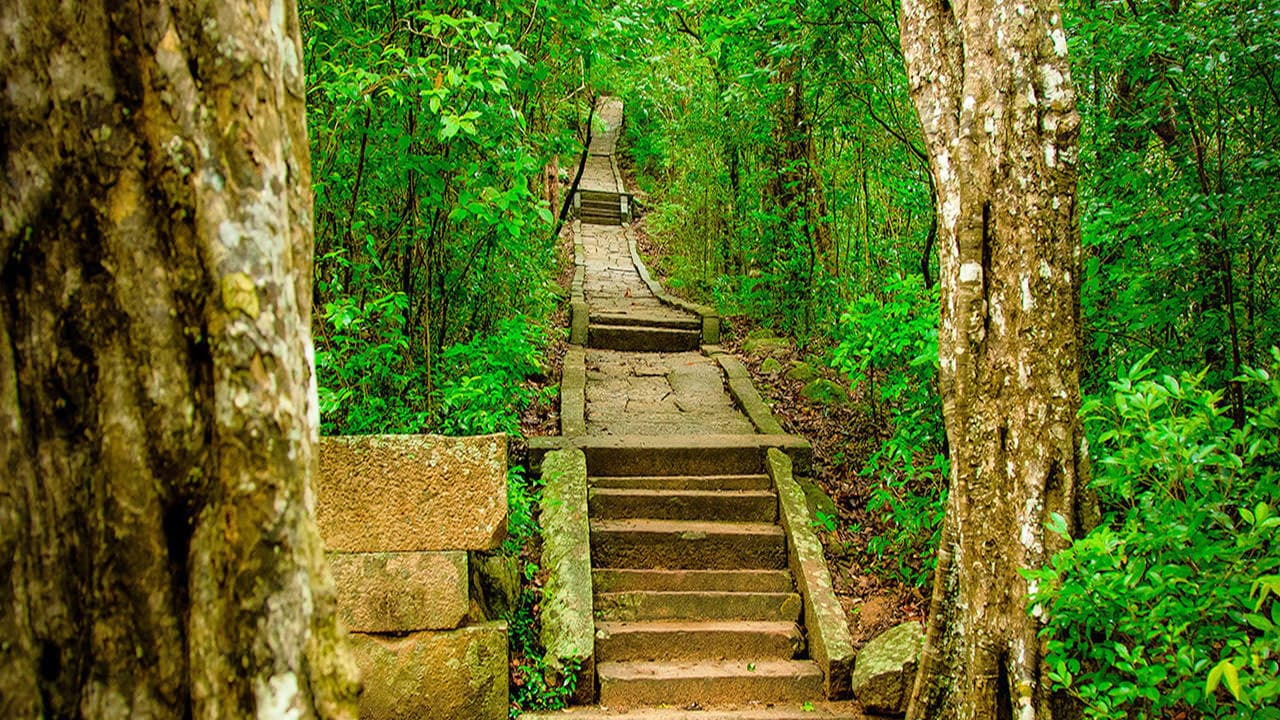
The ruins of Ritigala monastery are located on the eastern side of the mountain, at the foot of the gorge separating the main peak from the northern ridge. The ruins cover an area of 24 hectares, and the monastery precinct begins at the on-site Department of Archaeology branch near the foot of the reservoir named Banda Pokuna — an ancient man-made reservoir, a feat of engineering with a polygonal bund completing a circumference of 366m, credited to King Pandukabhaya (437–367 BC). The reservoir possibly served a ritual bathing purpose, with visitors bathing there before entering the monastery, in a procession similar to that of Kataragama, where pilgrims begin with a cleansing bath before making an offering at the main shrine. The edge of the reservoir is followed clockwise to the other bank, crossing the bed of the feeding stream before steep steps lead up to a beautifully constructed 1.5m-wide stone-paved path that meanders upward through the forest, linking the major buildings of the monastery. Three large circular platforms along the way allow for rest. According to inscriptional evidence, Ritigala is believed to date back to the 2nd and 4th centuries BC. The ruins of an ancient Buddhist monastery from the 9th century — the Lanka Viharaya, built by King Sooratissa during 187–177 BC — along with 152 stone inscriptions, 74 rock caves and 140 archaeological buildings are among the ancient remains found in the area.
Stone Bridges, Platforms & Courtyards
There are stone double-platform structures, called Padhanaghara, which are characteristic of Ritigala and other forest monasteries such as Arankele, Veherabandigala and the western monasteries at Anuradhapura. Spread over about 49 hectares are roughly fifty such double platforms — raised platforms formed by retaining walls of massive stones, found in pairs linked together by a stone bridge, with their main axis set exactly east–west. The structures were most likely roofed and divided into rooms, believed to be used for solitary practices such as meditation as well as congregational functions such as teaching and ceremony. Over a stone bridge lie interlocking ashlars and the ruins of a monastery hospital, where medicinal herb- and root-grinding stones and huge stone-cut Ayurvedic oil baths can still be seen. The pavement continues to reach one of several roundabouts; about 20m before reaching one, a path heads off through enormous tree roots to a lookout above a burbling stream, with another lookout and an artificial waterfall further along, contrived by placing a stone slab between two rocks. Beyond that lie two further sunken courtyards, the first containing one of the largest double-platform structures in the entire monastery, its pillars still preserving the remains of a supported building.
Legends of Ritigala
Legends abound on Ritigala. One belief holds that powerful medicinal herbs are found near the crest — a herb called 'Sansevi' is believed to confer long life and cure all human pain — and that all vegetation on the mountain is protected by Yakkas, guardian spirits of the mountain. Legend has it that Prince Pandukhabaya (3rd century BC) was assisted by Yakkas during his battles against his eight uncles at the foot of Ritigala, while another legend refers to a duel of two giants, Soma and Jayasena, with Soma killed and Jayasena becoming a legend. According to popular belief, Lord Hanuman, travelling over Ritigala carrying a chunk of the Himalayas laden with medicinal herbs meant for Prince Lakshmana, accidentally dropped a portion here — accounting for the pocket of healing vegetation at the strange mini-plateau at Ritigala's summit, distinct from the dry-zone flora of the surrounding plains. Having previously visited Lanka in search of Sita (held captive by King Ravana at Sita Eliya, near Nuwara Eliya), Hanuman is said to have used Ritigala Kanda as a launching pad to leap across to South India — fittingly, Ritigala is the highest prominence between the central plains of Sri Lanka and the coast of southern India.