The Villus of Wilpattu
Wilpattu National Park is located 25km north of Puttalam or 30km west of Anuradhapura, on the northwest coast, spanning the border between North Central Province and North Western Province of Sri Lanka. To the south is the River Modergam Aru; to the north is the River Kalay Oya. Wilpattu National Park consists of three types of vegetation: littoral vegetation, including salt grass and low scrub immediately adjacent to the beach; a 5–10km coastal belt of monsoon scrub of very low stature; and further inland, wooded forest with tall emergents such as Palu, Satin, Milla, Weera, Ebony and Wewarna. Some 73% of the park is dense forest or scrub, with the rest more open habitat. Wilpattu National Park spans no less than 131,693 hectares, with altitude ranging between sea level and 152m. The park is situated in the dry zone and is unlike any other wildlife sanctuary in Sri Lanka — a unique complex of over 50 wetlands called 'Villu' is the most prominent topographical feature, shallow natural lakes filled with rainwater surrounded by open grassy plains amidst dense scrub jungle. The period of drought lasts only from May to early September, with the main rainy season from September to December bringing heavy north-eastern monsoon downpours, while an inter-monsoon season visits the park in March and April. Annual temperature is around 27.2°C with roughly 1,000mm annual rainfall. The best time to visit is during February and October, and the park has a good network of gravel roads, particularly between the water holes.
Reaching Wilpattu National Park
The Colombo–Puttalam A3 highway leads to the city of Puttalam. 42km along the A12 Puttalam–Anuradhapura highway is a large sign board reading 'Wilpattu National Park', and 7km along the road that turns left at the sign board takes you to the entrance at Hunuwilagama. Wilpattu was declared a wildlife sanctuary in 1905, and on 25 February 1938 the sanctuary was elevated to the status of National Wildlife Park. On 7 November 1947, the northern area of Wilpattu was declared Wilpattu North Sanctuary. There are two park gates for entry: the Hunuwilagama Entrance and the Eluwankulama Entrance.
Wildlife of Wilpattu
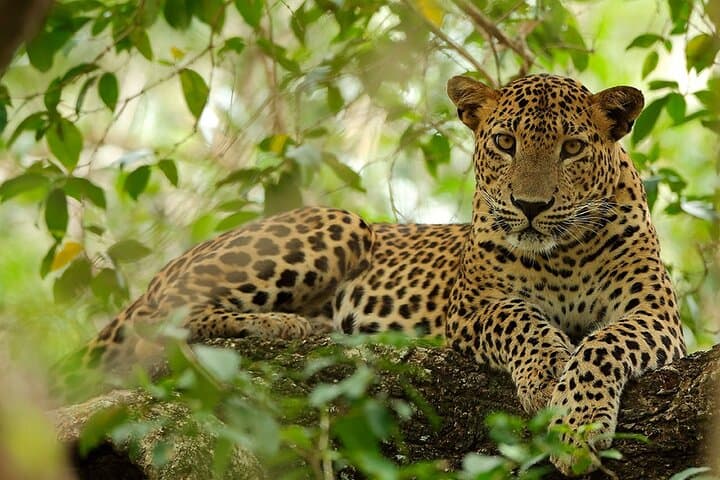
Wilpattu's varying natural habitats — coastal belt, natural lakes (villus), rocky outcrops, scrublands, open grasslands and dense forest — provide for numerous species of animals, among them 31 mammal species. The biggest draws are Leopards and Sloth Bears, alongside Asian Elephants, Spotted Deer, Barking Deer, jackals, sambhur, mouse deer, Wild Pig, Water Buffalo and Mugger Crocodiles. Butterflies recorded include the Great Eggfly, Blue Mormon, Common Mormon, Common Rose, Great Orange Tip, Glad-eye Bushbrown and Crimson Rose. Countless species of birds can be found, and the park plays host to numerous winter migrants from November to March, while crocodiles top the list of reptiles. Also roaming the grasslands are Star Tortoises, and in the large Villus are the Pond Turtle and the Soft-shelled Turtle. Wilpattu has no accommodation options within the park at present, though blueprints have been drawn to rebuild seven dilapidated circuit bungalows at Maradanmaduwa, Pannikar Villu, Kalli Villu, Mena Villu, Thala Villu, Manikkapola Uttu and Kokmottai — all but the Kokmottai bungalow overlook the lovely Villus. Campsites are also planned. For now, Anuradhapura, 30km away, provides regular accommodation options.
Cultural Heritage
Wilpattu National Park and its surroundings carry a history running as far back as the arrival of Prince Vijaya in Lanka from East India in 543 BC — the landing beach of Prince Vijaya is believed to be the area today known as Kudriamali, and Kali Villu is said to be the location of the palace of Kuveni, a princess of a native tribe on the island. Wirandagoda and Galbendi Niyara, located north-east of Maradanmaduwa, are believed to be two of the locations where Prince Saliya, who forfeited his right to the crown of Lanka, lived with his low-caste wife Asoka Mala a couple of millennia ago. At Pomparippu, several urns containing human remains have been found, believed to belong to a period prior to Sri Lanka's recorded history — that is, prior to the arrival of Prince Vijaya. In the eastern part of the park are remnants of breached tanks left over from the agricultural systems of ancient Sinhalese civilisations, and between Palangaturai and Kollankanatte are the remains of an old harbour.
Jeep Safaris
Jeep safari is the regular way to explore Wilpattu National Park. While leopards, elephants, sloth bear, deer and endemic birds can be sighted easily during a half-day safari, the full-day safari affords even greater wildlife encounters. During the safari, tourists are not permitted to get off the jeep at the tracks of wild animals or expose themselves to possible encounters in the wilderness. With rangers guiding the wildlife safaris, visitors are always kept safe even in the thick of the wilderness.