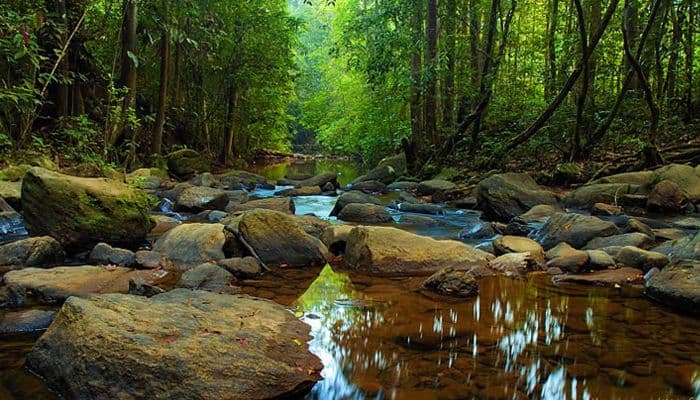
Reaching Sinharaja Rain Forest
From the northern or western parts of the country you can reach Sinharaja via Ratnapura, Kiriella, Kalawana and Weddala. From the south you can enter from Deniyaya, and coming from Hambantota or Udawalawe you can enter from the Rakwana side. The total area of the reserve is 18,900 acres (7,648 hectares), ranging in altitude from 300m to 1,170m. Meteorological records gathered over the last 60 years show annual rainfall ranging between 3,614mm and 5,006mm and temperatures from 19°C to 34°C, with the highest rainfall driven by two monsoons — the south-west monsoon during May–July and the north-east monsoon during November–January. The forest is a narrow strip of undulating terrain, made up of a series of ridges and valleys drained by an intricate network of streams that flow into the Gin Ganga on the southern boundary and the Kalu Ganga, via the Napola Dola, Koskulana Ganga and Kudawa Ganga, on the northern boundary.
Sinhagala Nature Trail
The two main nature trails of Sinharaja lead to the peaks of Moulawella and Sinhagala, both beginning at the Kudawa Conservation Centre (KCC) and equally enjoyable and enlightening. The Sinhagala trail runs 2.4km, rising from 300m at the trail head to 473m at the trail end, taking around 5–7 hours to hike; the best months are December to April. The forest is densely crowded with tall trees growing in close proximity, but winding trails make the trekking manageable, with small streams of crystal-clear cool water — home to fish, toads and crabs — crisscrossing the paths, and mixed species of birds visible in the canopy above.
Mulawella Nature Trail
Also beginning at the Kudawa Conservation Centre, the Mulawella trail runs 2.4km, rising from 457m at the trail head to 758m at the trail end, and takes roughly 1–2 hours — a shorter, more accessible option than the Sinhagala trail, with the same December-to-April hiking season recommended.
Establishment & Significance
Most of the area of Sinharaja forest was originally declared a forest reserve under the Waste Lands Ordinance in 1875. In 1978, the rainforest was included in the international network of biosphere reserves under UNESCO's Man and the Biosphere (MAB) programme. In October 1988, together with a north-eastern extension, it was declared Sri Lanka's first National Wilderness Heritage Area, and in December 1988 the Sinharaja Biosphere Reserve became Sri Lanka's first natural site added to the UNESCO World Heritage list. The reserve is home to over 50% of Sri Lanka's endemic species of mammals and butterflies, as well as many kinds of insects, reptiles and rare amphibians.
Birdlife in Sinharaja
Sinharaja is home to numerous indigenous birds such as the Ceylon Hanging Parrot, the Ceylon Grey Hornbill, the Ashy-headed Laughing Thrush, Layard's Parakeet, the Jungle Fowl, the Spur Fowl, the Ceylon Wood Pigeon, the Brown-capped Babbler, the Red-faced Malkoha and the Ceylon Blue Magpie, among others prominent in the area. 19 of Sri Lanka's 20 endemic bird species are found in the Sinharaja Reserve, including the endangered Sri Lanka Wood Pigeon, Green-Billed Coucal, Sri Lankan White-headed Starling, Red-faced Malkoha, Sri Lanka Spurfowl, Sri Lankan Blue Magpie and Ashy-headed Babbler, all of which are endemic.
Mammals, Reptiles & Butterflies
Of 12 endemic mammal species in the country, 8 are found here. The Giant Squirrel, Dusky-striped Jungle Squirrel, Badger Mongoose and endemic Purple-faced Leaf Monkey and Toque Macaque are frequently seen, along with many threatened species of mammals, reptiles, amphibians and butterflies, including the leopard — endemism among mammals and butterflies here is greater than 50%. Reptiles and amphibians include python, the endemic green pit viper, the endemic hump-nosed lizard and the rough-nosed horned lizard.
Conservation Value
Sinharaja is the last extensive primary lowland tropical rainforest in Sri Lanka. It holds a large number of endemic species of plants and animals, and a variety of plants of known benefit to man — over 60% of the trees are endemic, many of them rare, and there are 21 endemic bird species along with a number of rare insects, reptiles and amphibians. The long-term success of conserving Sinharaja depends on sustainable development of its buffer and peripheral zones through a participatory approach emphasising the involvement of local people; construction of hotels on peripheral zones and roads over protected areas are bound to result in irrecoverable damage to this World Heritage Site.